Amlogic A311Y3: The New 6nm Edge AI Chipset Explained
Amlogic just raised the bar again. On June 23, 2026, the company unveiled the Amlogic A311Y3, a next-generation system-on-chip built on TSMC’s advanced 6nm process. This time, the focus is not just streaming. Instead, Amlogic is chasing the fast-growing edge AI market head-on.
Consequently, this launch matters far beyond the TV box world. The A311Y3 targets robotics, AI tablets, interactive flat panels, and premium set-top boxes all at once. In other words, it is a true full-scenario platform. Below, we break down what makes it special, and why it could reshape the AIoT landscape.
Why the Amlogic A311Y3 Signals a Strategic Shift
For years, Amlogic dominated the Android TV box market with its S-series chips. However, the A311Y3 belongs to a different family entirely. It sits in the “A” line, which has always leaned toward AI and industrial computing.
Moreover, the naming is telling. The A311Y3 succeeds the older A311D and A311D2, both popular in single-board computers and AI cameras. Therefore, this chip continues a proven lineage, but with a dramatic generational leap.
Notably, James Xie, Senior Vice President of Corporate Business Strategy at Amlogic, called the launch a defining milestone. He described the A311Y3 as the pioneer of a new family of high-performance AI processors. Clearly, Amlogic is thinking bigger than living rooms now.
Inside the Amlogic A311Y3 Architecture
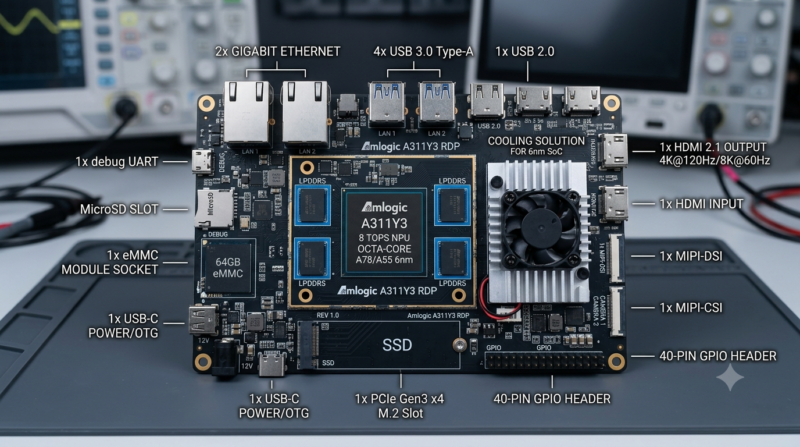
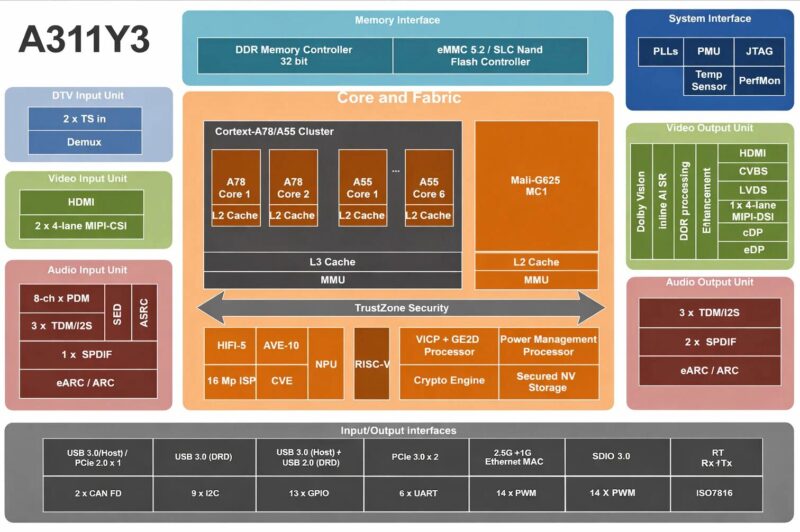
At its core, the chip uses a powerful octa-core big.LITTLE layout. Specifically, it pairs two Arm Cortex-A78 cores with six Cortex-A55 cores. As a result, it delivers strong burst performance alongside excellent efficiency.
This is a big upgrade over the older A311D. That earlier chip relied on Cortex-A73 and A53 cores. By contrast, the Arm Cortex-A78 architecture brings modern instruction sets, better IPC, and higher clock headroom.
Graphics duties fall to the Arm Mali-G625 GPU. Importantly, this GPU ships with Long-Term Support, which helps manufacturers extend product lifecycles. Furthermore, it supports Vulkan 1.4 for advanced rendering and parallel AI acceleration.
Memory bandwidth also gets a serious boost. The A311Y3 supports up to 16GB of LPDDR5X running at 6400 MT/s. Thanks to that speed, complex multitasking and real-time AI computing stay smooth under load.
The 8 TOPS NPU That Powers On-Device AI
Undoubtedly, the headline feature is the AI engine. Amlogic built a proprietary NPU rated at 8 TOPS directly into the silicon. That figure represents a meaningful jump over the 5 TOPS A311D and the 3.2 TOPS A311D2.
More importantly, this NPU is purpose-built for modern workloads. It can run Large Language Models, Vision-Language Models, and other transformer-based models directly on the device. Because inference happens locally, data privacy improves and response times shrink.
For developers, this opens exciting doors. Picture a smart display that answers questions offline, or a robot that navigates without cloud latency. Indeed, on-device intelligence is exactly where the industry is heading, and the A311Y3 arrives ready for it.
Cinematic Multimedia and Multi-Camera Vision
Of course, Amlogic did not abandon its multimedia roots. The A311Y3 supports 4K video decoding at 120fps, including native AV1 support. Additionally, it handles 4K encoding at 60fps for capture-heavy applications.
Picture quality benefits from the 9th-generation TruLife Image Engine. On top of that, integrated hardware AI Super Resolution upscales images in real time without draining bandwidth. It also fully supports Dolby Vision, HDR10, HDR10+, and HDR Vivid.
Display flexibility stands out too. The chip can drive dual 4K screens at once, or split output across 4K and 2.5K panels. To achieve this, it offers LVDS, MIPI DSI, eDP, V-by-One, and HDMI 2.1 interfaces.
Finally, an integrated 16M30 ISP processes up to four camera sensors simultaneously. As a result, multi-camera perception becomes practical for robots, kiosks, and security systems.
Industrial Reliability and Post-Quantum Security
Edge deployments often live in harsh conditions. Therefore, Amlogic offers the A311Y3 in both consumer and industrial temperature grades. Better still, the chip carries a minimum 10-year product longevity guarantee.
Security also gets a forward-looking treatment. The SoC integrates Arm TrustZone, robust DRM, and compliance with the EU Cyber Resilience Act. Most impressively, it introduces standards-compliant Post-Quantum Cryptography.
That last point deserves attention. Quantum computers threaten today’s encryption, so building quantum-resistant protection now is smart future-proofing. Consequently, devices built on this chip should stay secure for years to come.
Connectivity rounds out the industrial story. The platform includes PCIe 3.0, dual Gigabit Ethernet, 2.5Gbps Ethernet, dual CAN FD, and a HiFi 5 DSP. Because of this, it slots neatly into robotics and edge-analytics gateways.
A Developer-First Software Ecosystem
Great hardware still needs great software. Fortunately, Amlogic ships the A311Y3 with broad operating system support. Out of the box, it runs Android 16, Yocto Linux, and Debian.
Even better, core drivers and kernel code are being upstreamed to open-source repositories. In practice, that means lower long-term maintenance overhead for engineering teams. Reportedly, an Amlogic engineer has already submitted initial mainline Linux kernel patches for the new A9 family, as detailed by CNX Software.
For makers and OEMs, reference hardware is emerging fast. Vendors have shown development boards with the A311Y3, up to 16GB of RAM, and a full spread of industrial interfaces. Naturally, this accelerates time-to-market for custom products.
How the Amlogic A311Y3 Compares to the S928X-J
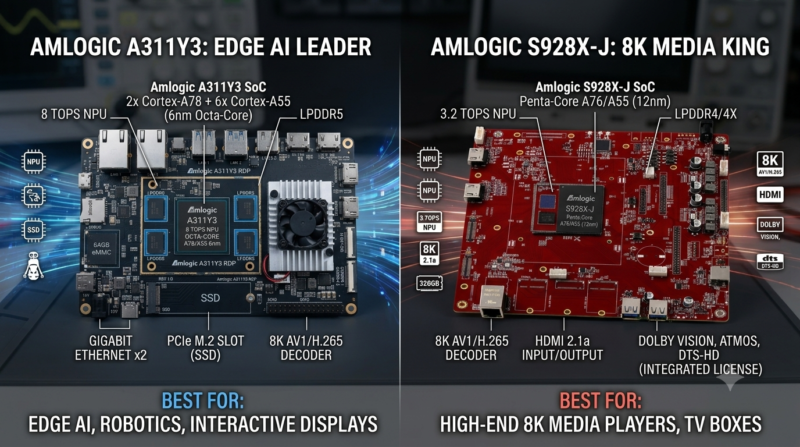
Some readers will wonder how this fits alongside the flagship S928X-J. Simply put, the two chips chase different goals. The S928X-J targets 8K home cinema, while the A311Y3 chases edge AI and industrial versatility.
That said, the A311Y3 still shines in the living room. It enables 4K@120fps streaming, native AV1 decoding, and Dolby Vision. For most premium set-top boxes, that combination is more than enough.
Ultimately, buyers should match the chip to the use case. Choose the S928X-J for raw 8K decode. Meanwhile, pick the A311Y3 when on-device AI, multi-camera input, or industrial longevity matters most.
Final Thoughts on the Amlogic A311Y3
The A311Y3 is more than a spec-sheet upgrade. Rather, it signals Amlogic’s confident push into edge AI, robotics, and intelligent displays. With a 6nm process, an 8 TOPS NPU, and post-quantum security, it feels genuinely future-ready.
For device builders, the appeal is obvious. This one platform can power tablets, panels, robots, and streamers alike. As edge AI adoption accelerates, expect to see this chip inside a growing wave of smart devices.
Sources and further reading: the official Amlogic website, the A311Y3 press release on EIN Presswire, the detailed CNX Software technical breakdown, and Arm’s Mali GPU overview.